The Meaning of the logos
Certification logos are much more than simple visual elements: they represent, at a glance, the result of a rigorous assessment process.
However, their value depends entirely on who issues them.
Only logos delivered by independent certification bodies, such as TÜV AUSTRIA OKcert, can guarantee a credible and impartial evaluation.
These organisations assess products against defined standards through testing, analysis, and third-party verification.
This independence is essential to ensure the reliability of environmental claims and to avoid misleading or self-declared labels.
For authorities and industry, such logos strengthen credibility; for citizens, they provide a trustworthy reference to make informed decisions with confidence
OK compost INDUSTRIAL
Note
- This is not a sorting instruction.
Always check with your local waste collection authority. - A product certified for industrial composting will not necessarily break down when composted at home.
More about the difference between home and industrial composting
Seedling logo
Note
- This is not a sorting instruction.
Always check with your local waste collection authority. - A product certified for industrial composting will not necessarily break down when composted at home.
More about the difference between home and industrial composting
OK compost HOME
It is owned and managed by TÜV AUSTRIA OKcert.
Note
- home composting does not mean simply dumping your organic waste at the bottom of your garden.
- Home compositng does require (a little) effort.
- A product certified for industrial composting will not necessarily break down when composted at home.
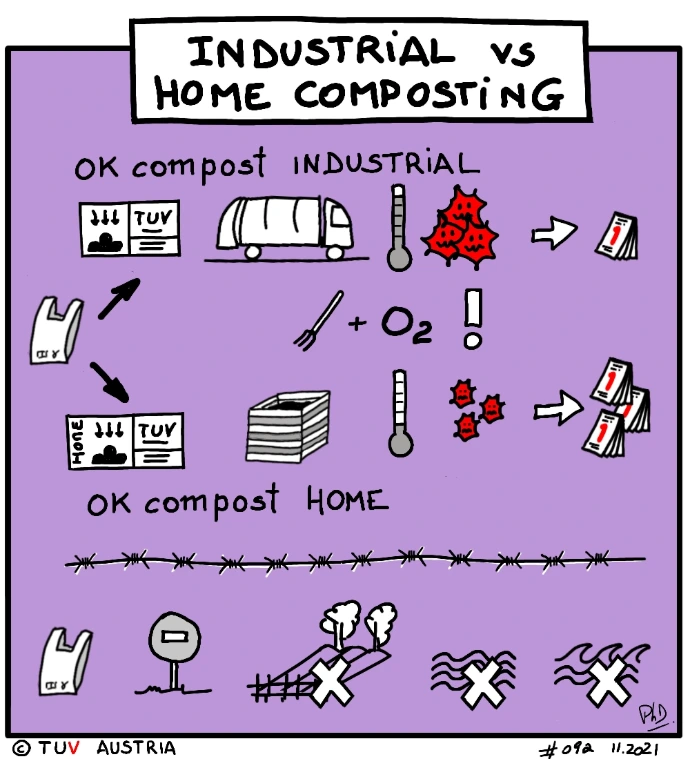
What is the difference between home and industrial composting ?
But the conditions are different.
OK biodegradable
SOIL
It is owned and managed by TÜV AUSTRIA OKcert.
Certified products will biodegrade in soil and break down within a timeframe that depends mainly on their function.
Please note: certification is not a licence to dispose of waste in the natural environment.
OK biodegradable
WATER
Certified products will biodegrade in soil and break down within a timeframe that depends mainly on their function.
Please note: certification is not a licence to dispose of waste in the natural environment.
OK biodegradable MARINE
Certified products will biodegrade in soil and break down within a timeframe that depends mainly on their function.
Please note: certification is not a licence to dispose of waste in the natural environment.
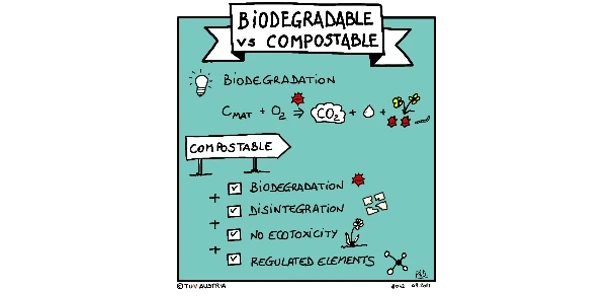
What is the difference between biodegradable and compostable ?
A material is biodegradable if microorganisms can break it down into CO₂, water, and biomass within a set time under specific environmental conditions.
A product is compostable if its biodegradable materials fully disintegrate within a defined time without harming the environment.
Learn more
OK recycled
Based on the mass balance approach, the actual percentage may vary from one item to another, but the percentage has been verified across the entire production process.
OK biobased
Based on a measurement method (C14), the certified percentage is present in every item.
OK renewable
Combining underlying certificates based on laboratory measurements and mass balance, the actual percentage may vary from one item to another, but it has been verified throughout the entire production process.

NEN biobased %
This logo indicates that the product contains a proportion of bio-based material.
Developed in collaboration with NEN (Netherlands Standardization Institute), which owns it, TÜV AUSTRIA OKcert is responsible for the assessment and certification of this conformity mark.
As the certification is based on laboratory analyses, the product contains the stated proportion of bio-based material.
In European Countries
Industrially Compostable (UK)
Note
- This is not a sorting instruction.
Always check with your local waste collection authority. - A product certified for industrial composting will not necessarily break down when composted at home.
More about the difference between home and industrial composting
Home Compostable
(UK)
Note
- home composting does not mean simply dumping your organic waste at the bottom of your garden.
- Home compositng does require (a little) effort.
- A product certified for industrial composting will not necessarily break down when composted at home.
CIC
(Italy)
Prior to these real-world tests, the products must be certified according to the OK compost INDUSTRIAL or Seedling logo (by TÜV AUSTRIA OKcert).
Cré
(Ireland)
Prior to these real-world tests, the products must be certified according to the OK compost INDUSTRIAL or Seedling logo (by TÜV AUSTRIA OKcert).
In USA
BPI Industrial
BPI Industrial & Home
To be certified as home-compostable, products must also be composted in an industrial setting. Hence the label covering both environments
In Australia
Industrially compostable
Australian version of the Seedling logo, owned by the Australasian Bioplastics Association.
Home compostable
Australian home compostable logo, owned by the Australasian Bioplastics Association.
Biodegradable in the soil
Australian logo for biodegradation in the soil, owned by the Australasian Bioplastics Association.