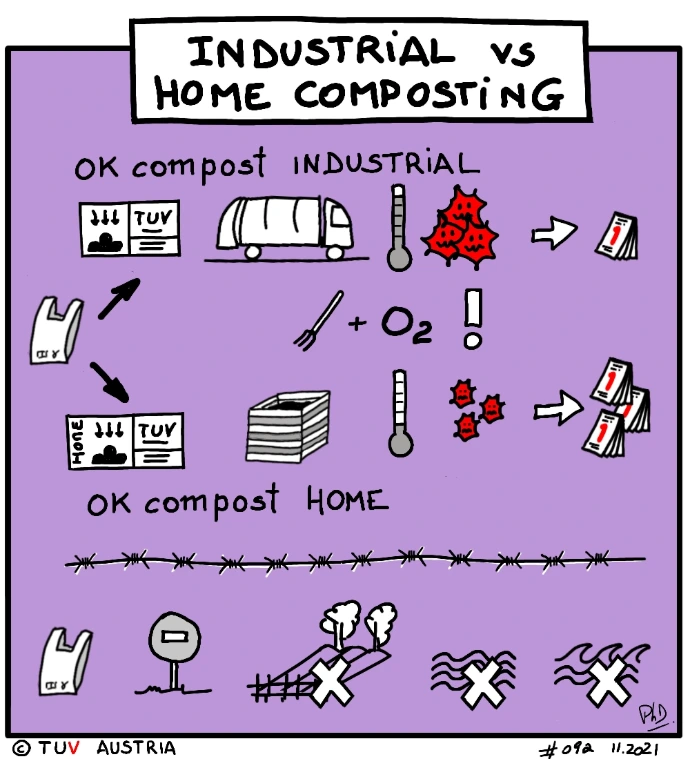
industrial vs home compostable
Home composting and industrial composting are based on the same
principles: the transformation of the material into CO2, water, and biomass by
micro-organisms.
But the conditions are different.
Industrial composting is performed in special facilities, which can handle very large quantities of bio-waste. The temperatures are high, and all the conditions are met to obtain quality compost in a relatively short time.
It is a real paradise for micro-organisms.
In home composting, on the other hand, the addition of fresh material is less frequent and important. This reduces the temperature and slows down the process considerably.
But in both cases, industrial or domestic, the supply of oxygen is essential, without which the process would be greatly slowed down, or even become anaerobic, with production of methane (CH4) instead of CO2.
It is therefore necessary to regularly turn the compost to aerate it, and not to confuse domestic composting with abandoning bio-waste in the back garden.
Please note that in any case, a product that can be composted, even at a low temperature at home, does not mean that it will biodegrade (correctly) in the environment, in soil, in fresh or sea water.
It is therefore completely unacceptable to abandon your waste, whatever it may be, in the environment.