Standards
Standards play a fundamental role in structuring the world of compostable, biodegradable, biobased, and renewable materials. They define a common framework by setting clear criteria, test methods, and performance thresholds that products must meet.
By harmonising definitions and methodologies, standards ensure that environmental claims are measurable, comparable, and scientifically grounded. They provide a shared language for industry, regulators, and consumers alike.
As a result, standards are essential to bring consistency, credibility, and transparency to the market, and to support informed decisions while limiting confusion and misleading claims.
Please note that, unlike European legislation, which is freely available, standards are subject to a fee.
Standards
In the field of bio-based, biodegradable, or compostable products standards play a crucial role in ensuring product quality, environmental claims, and mutual understanding across industries.
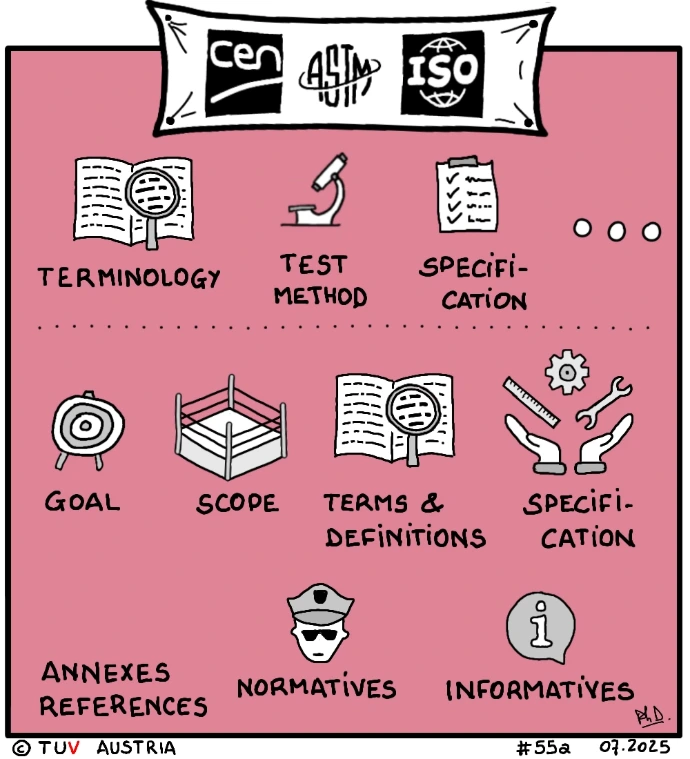
Among the many types of standards, three are particularly important: terminology standards, test method standards, and specification standards. Although they serve different purposes, they share a common structure that makes them easier to read, apply, and harmonize internationally.
Example : EN 16575 defines terms related to
bio-based products, such as “bio-based content” and “renewable raw materials”.
These standards do not set performance requirements but ensures consistent
language across documents and stakeholders.
Example: ISO 14855 specifies a method for measuring
the aerobic biodegradation of plastics under composting conditions.
These standards
ensure that results are reproducible and comparable across laboratories.
Define the requirements
a product must meet to be considered compliant with a certain claim or
application.
Example: ASTM D6400 sets the criteria for
compostability of packaging materials: disintegration, biodegradation,
no ecotoxic effects on compost, and limits on heavy metal content.
These standards refer
to several test method standards to verify these requirements.
- Goal : Explains why the standard was developed, what problems it addresses, and how it fits into a broader framework or system àinformative and explanatory.
- Scope : Defines the boundaries of the standard, specifying what the standard covers and what it does not. → precise and technical
- Terms and Definitions Clarifies the vocabulary
Technical content: Requirements or Methods, the core section :
- For specifications: technical criteria to meet
- For test methods: detailed procedures
- For terminology: standardised definitions
- Normative References
A listing of other standards that are essential for applying the current one correctly &
Normative Annexes
Like appendix E of EN 13432, which amends certain points of another underlying standard
These annexes are mandatory: without them, it is impossible to comply to the standard Informative References (bibliography) or
Informative Annexes like the appendix Z in harmonized standards.EU Harmonised Standards are developed by a standardisation organization (like CEN) to support EU legislation.
- When products comply with these standards, they are presumed to meet the essential requirements of relevant EU directives or regulations.
These annexes are explanatory: for further reading,
Standardisation vs legislation
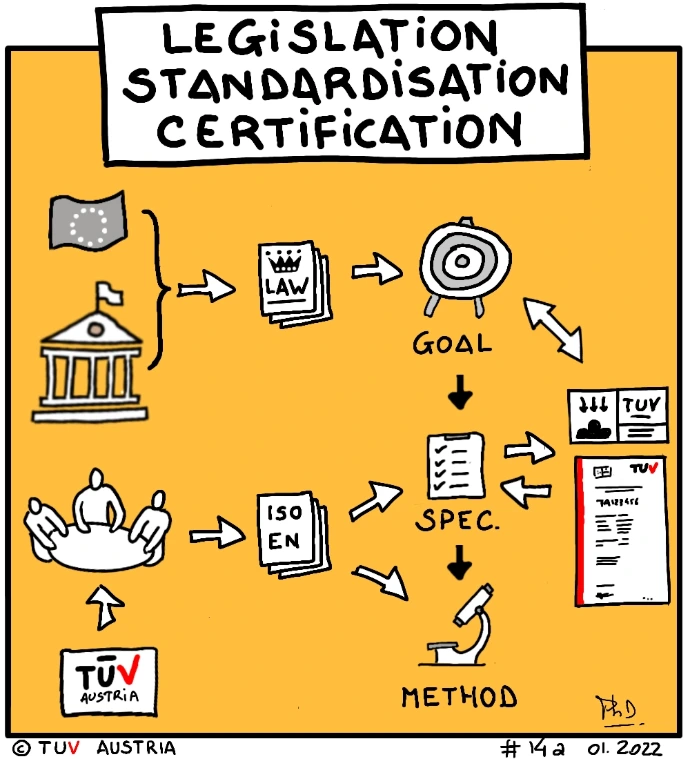
Contrary to popular belief, a norm is not binding as such. It only becomes binding when it is included in a law (or in a contract between two parties).
A standard is a common,
documented reference framework designed to harmonise an industrial activity.
Resulting from a consensus, it is developed - generally at international level
- by a working group, bringing together experts from different backgrounds:
authorities, industry, academia, civil society.
Certification allows manufacturers to have their product(s) independently assessed for compliance with a given standard, and to communicate this compliance without having to disclose their composition or manufacturing secrets.
The legislator, for its part, will define the goals, for example the European directive 94/62/EC, and its multiple amendments, specifies that packaging must be recyclable (EN 13430), energetically recoverable (EN 13431) or compostable (EN 13432).
This without having to specify what is meant by compostable and even less how to measure it.
To each his business.
The best way to demonstrate a product's compliance with legislation is to show that it complies with the underlying standard, and the best way to do this is through assessment by an independent certification body.
Industrial compostability
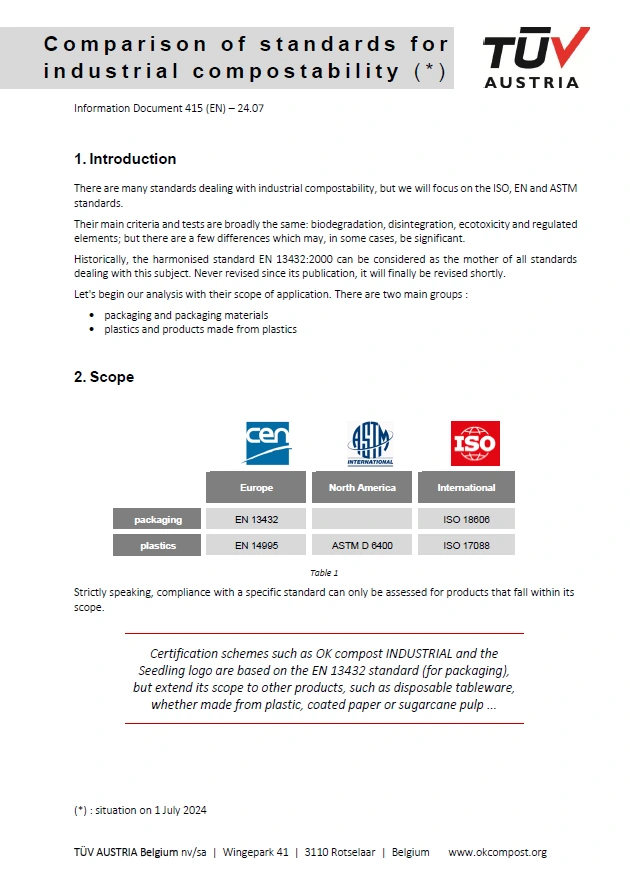
Historically, the harmonised standard EN 13432:2000 can be considered as the mother of all standards dealing with this subject. Never revised since its publication, it will finally be revised shortly.