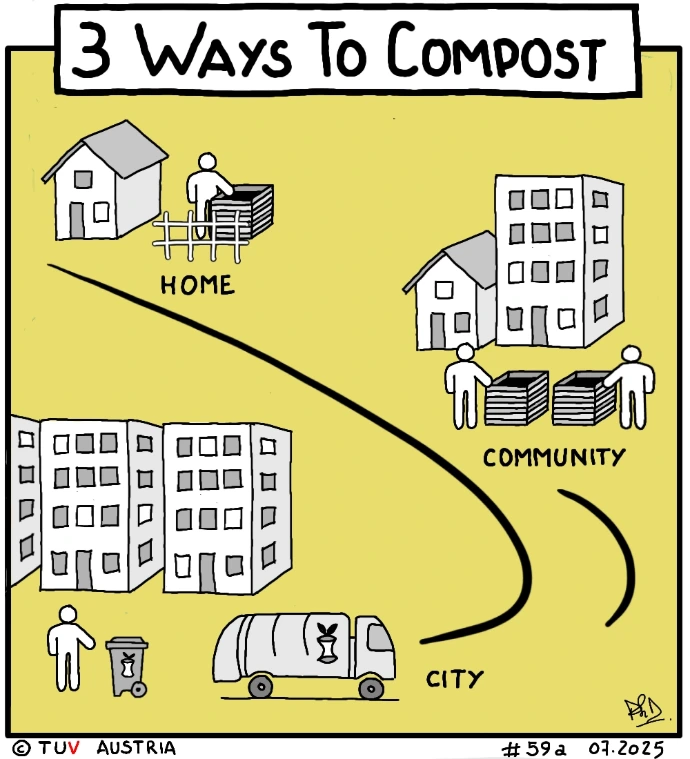
3 ways to compost
Every day,
despite the EU obligation to recycle biowaste, too many of us throw away
organic waste that could easily be turned into compost! Peelings, coffee
grounds, leftovers: instead of incinerating them, we can recycle them.
There are several ways to compost. Here are 3 (+1) solutions, with their pros and cons.
1. HOME composting
This is the simplest method: a compost bin in the garden where you put your biodegradable waste. In a few months, you get natural, free compost.
Pros:
- Independent, economical and no transport required.
- Ideal for reducing waste at source.
- The compost can be used directly in the garden.
Cons:
- Requires outdoor space.
- Requires attention (aeration, moisture, proper sorting).
- Risk of odours or insects if not managed properly.
Who is it for? For people living in houses with gardens.
There’s an
even easier alternative to set up, as it doesn’t require a garden, a terrace or
even a place in the kitchen is enough: worm composting.
However,
one must overcome a common bias that can be hard to shake: having earthworms at
home...
2. COMMUNITY (neighbourhood) composting
If you
don't have a garden, you can compost with others.
These
collective bins are set up in a residential area, at the foot of a building or
on a street corner and are managed by a group of neighbours.
Pros:
- Accessible even in towns and cities.
- Creates social links between neighbours.
- Enables local waste management.
Cons:
- Only works if all participants are motivated.
- Requires a minimum of organisation.
- Can be problematic if poorly maintained (illegal dumping, nuisance).
Who is it for? Residents of apartment buildings or urban neighbourhoods.
3. INDUSTRIAL composting with collection or drop-off
Here, biowaste is collected or dropped off at specific points and then sent to a industrial treatment centre.
Pros:
- Convenient for densely populated areas or large producers (canteens, shops).
- Can handle large volumes.
- Controlled and hygienic process.
Cons:
- Higher costs (collection, transport, treatment).
- Carbon impact linked to transport.
- Little return to the user: the compost goes elsewhere.
Who is it for? Local authorities, large cities, public institutions.
In summary: Each solution has its place. The most effective approach is to combine these methods according to local circumstances, keeping the ultimate goal in mind: to give back to the earth what it has given us.