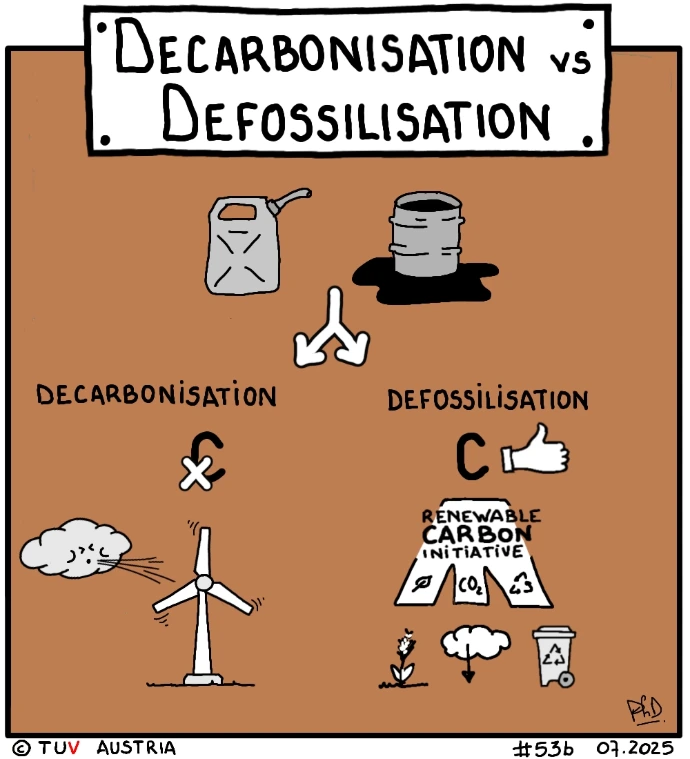
decarbonisation vs defossilisation
Defossilisation and decarbonisation: two key concepts that should not be confused.
Understanding the difference is crucial for shaping effective sustainability strategies.
Let’s clear the confusion using the definitions proposed by the Renewable Carbon
Initiative (RCI).
Decarbonisation
Strictly speaking, decarbonisation refers to the energy sector, and this is where the
term comes from. It refers to replacing carbon-containing fuels such as gasoline
and diesel with carbon-free fuels, such as hydrogen, ideally sustainably produced,
or electricity generated by renewable methods. In the field of chemistry and materials,
the strict definition is not applicable, since here carbon is an essential and
indispensable component. To avoid misunderstandings, the RCI recommends the
utilisation of the term “defossilisation” for transformation towards “renewable carbon”,
coupled with renewable energy to reduce greenhouse gas emissions of the
sector to zero.
Defossilisation
Defossilisation involves the replacement of fossil carbon (carbon found below the
ground) derived from coal, oil, and natural gas with renewable carbon sources
(carbon obtained from above the ground). This shift is crucial for achieving net-zero
emissions in the chemicals and materials industry, given that the majority of
chemicals and materials are primarily composed of carbon that is embedded in the
molecular structure. Renewable carbon, sourced from the biosphere, atmosphere,
and technosphere is maintained in a continuous cycle. This circular approach is essential
for significantly reducing Scope 3 emissions, minimising our carbon footprint,
reducing the necessity for CO2 removal to achieve net zero, and ensuring a reliable
supply of renewable carbon for industries dependent on chemicals and materials.
Defossilisation, representing the transition from fossil to renewable carbon within the
chemicals and materials sector, and decarbonisation, achieved through renewable
energy sources (such as solar, wind, hydro, and geothermal) in the energy sector,
share the common goal of preventing the introduction of additional fossil carbon
into the cycle.
As long as carbon comes from fossil sources, its use contributes to increasing the
concentration of CO2 in the atmosphere.