microplastics
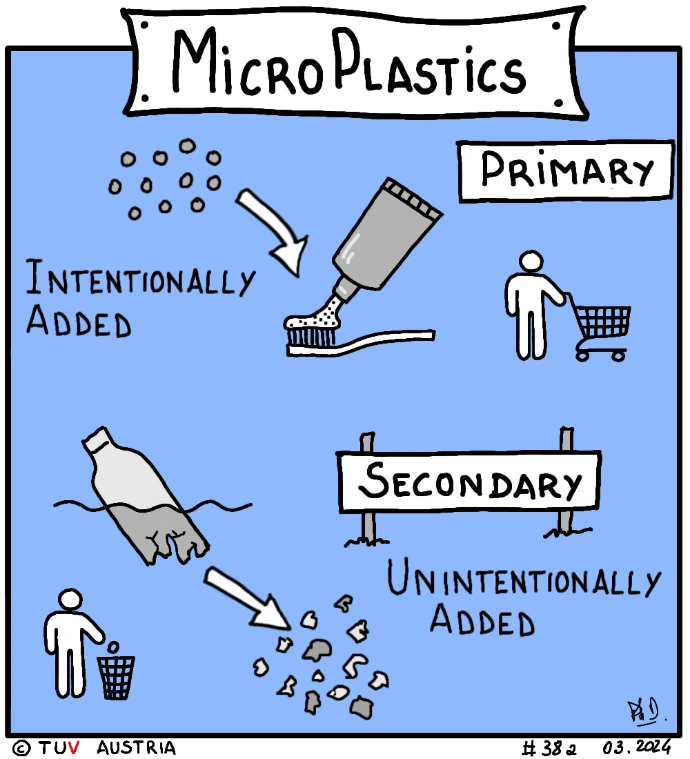
There are two main categories of
microplastics:
- those that are intentionally added to a product to give it special characteristics and;
- those that result from the degradation of a larger product.
Primary microplastics = intentionally added: industrially manufactured for specific purposes in the form of synthetically based granulates and pellets.
- agriculture and horticulture
- cosmetic products
- detergents and maintenance products
- paints, coatings and inks
- …
Secondary microplastics = Unintentionally added:
occurring through chemical / physical ageing and degradation processes of products such as plastic bags, plastic bottles or tyre wear particles.
As far as we know today, the microplastics found in the environment consist mainly of secondary microplastics.
- synthetic fibres from textiles
- vehicle tyres and brakes
- synthetic paints and coatings
- plastic waste
- …
There is currently no harmonised definition of microplastics, but material and size are predominant factors.
ISO/TR 21960:2020 defines microplastics as any solid plastic particle insoluble in water with any dimension between 1 μm and 1 mm, while Commission Regulation [i] (EU) 2023/2055 defines the intentionally added microplastics as particles containing solid polymer, to which additives or other substances may have been added, and where ≥ 1% w/w of particles have :
- all dimensions 0,1µm ≤ x ≤ 5mm, or
- for fibers, a length of 0,3 µm ≤ x ≤ 15mm and length to diameter ratio of >3
[i] Commission Regulation (EU) 2023/2055 amending Annex XVII to Regulation (EC) No 1907/2006 of the European Parliament and of the Council concerning the Registration, Evaluation, Authorisation and Restriction of Chemicals (REACH) as regards synthetic polymer microparticles.