biobased vs biodegradable - part 1 & 2
Biobased and biodegradable are two distinct concepts.
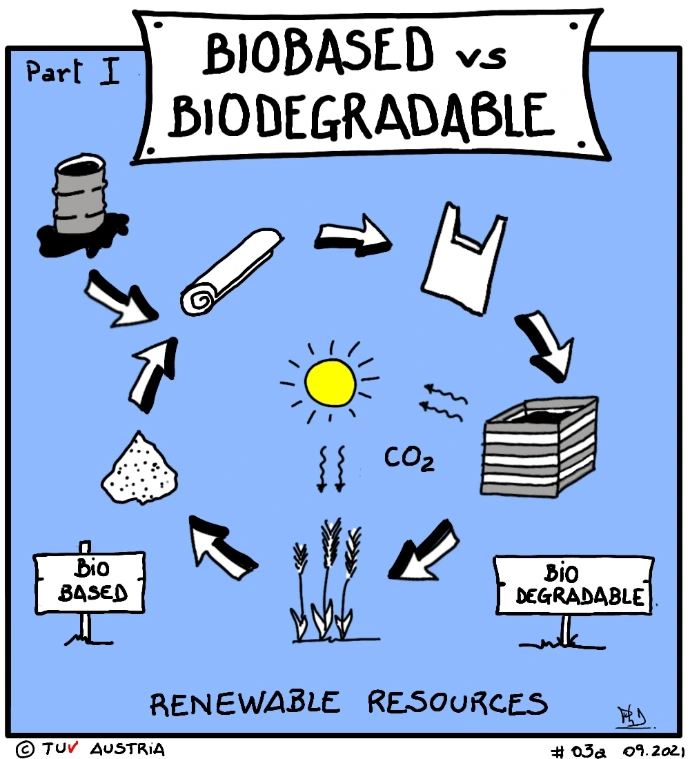
Biobased refers to the renewable origin of a material, as opposed to a fossil origin, while biodegradability characterises the end of life of a material (see sketch 01)
That said, a product that is both 100% biobased AND biodegradable has the great advantage of presenting a closed carbon loop: CO2, water and biomass from biodegradation feed the growth of plants that can themselves be transformed into biomaterial and so on. Biodegradation is in a way the reverse of photosynthesis.
The addition of components of fossil origin will, by definition, degrade the level of biobased material.
On the other hand, depending on the case, this addition will or will not modify the capacity of the finished product to biodegrade.
Indeed, a biodegradable material is appetising to micro-organisms, regardless of its fossil or biobased origin.
Not everything that is biobased is biodegradable and not everything that is biodegradable is biobased.
That is why two different schemes and logos are needed, and why a certification body is needed.
As explained here abvoe, biobased and biodegradable are two distinct concepts and not everything that is biobased is necessarily biodegradable and vice versa.
Another important aspect is that a product can be partially or fully biobased.
Being only 20% biobased is better than not being biobased at all.
On the contrary, a claim of partial biodegradability is not allowed: a material is either declared biodegradable or it is not, and there are no half measures possible.
The criterion 90% of transformation of carbon into CO2 in the standards does not mean that the material is only 90% biodegradable, but simply that the remaining 10% will take a little longer to biodegrade than the time set for the test, or will be absorbed by the micro-organisms which will have worked with the process.
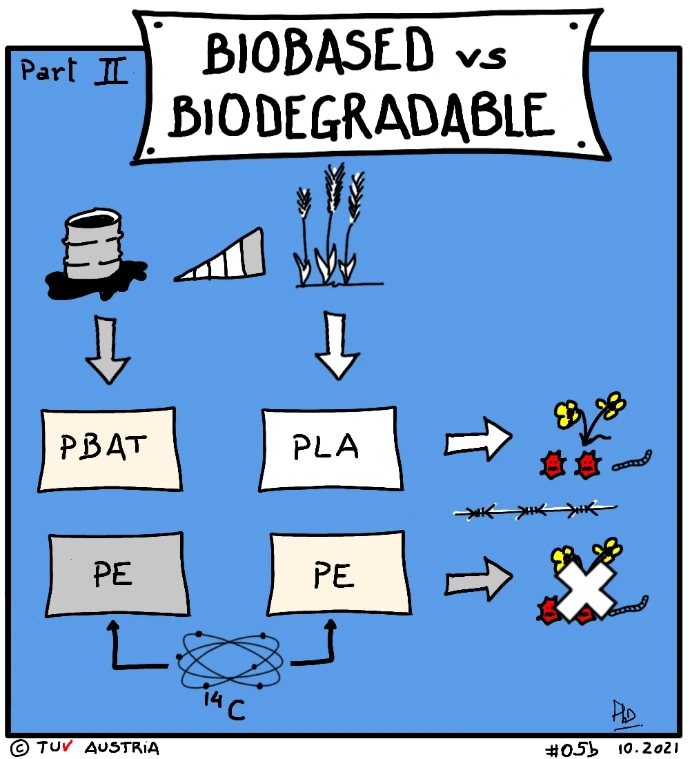
So, there are materials of fossil origin that are biodegradable (e.g. PBAT) and biobased products that are not (e.g. sugarcane-based PE).
In the case of products that can be either of fossil origin or biobased (such as PE in the sketch), since the molecule is absolutely identical, the only way to determine the fossil part of the biobased one is to carry out a carbon-14 analysis.