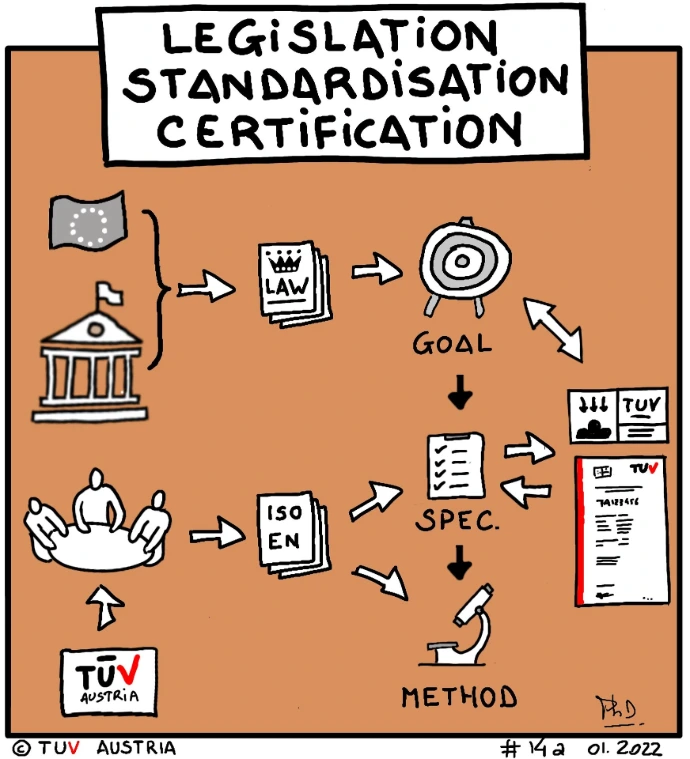
legislation - standardisation - certification
Contrary to popular belief, a
norm is not binding as such. It only becomes binding when it is included in a
law (or in a contract between two parties).
A standard is a common, documented reference framework designed to harmonise an industrial activity. Resulting from a consensus, it is developed - generally at international level - by a working group, bringing together experts from different backgrounds: authorities, industry, academia, civil society.
Standards defines
- product specifications setting out criteria (such as EN 13432 for the industrial compostability of packaging, specifying that biodegradation must reach 90% in a maximum of 6 months);
- test methods to measure the parameters used in the specification standards (e.g. ISO 14855-1 which defines how to perform the test & measure the biodegradation).
TÜV AUSTRIA experts participate in numerous working groups to share their experience and competence.
Certification allows manufacturers to have their product(s) independently assessed for compliance with a given standard, and to communicate this compliance without having to disclose their composition or manufacturing secrets.
Please note that we never certify a product according to a test method because this does not prove anything.
The legislator, for its part, will define the goals, for example the European directive 94/62/EC, and its multiple amendments, specifies that packaging must be recyclable (EN 13430), energetically recoverable (EN 13431) or compostable (EN 13432).
This without having to specify what is meant by compostable and even less how to measure it.
To each his business.
The best way to demonstrate a product's compliance with legislation is to show that it complies with the underlying standard, and the best way to do this is through assessment by an independent certification body.